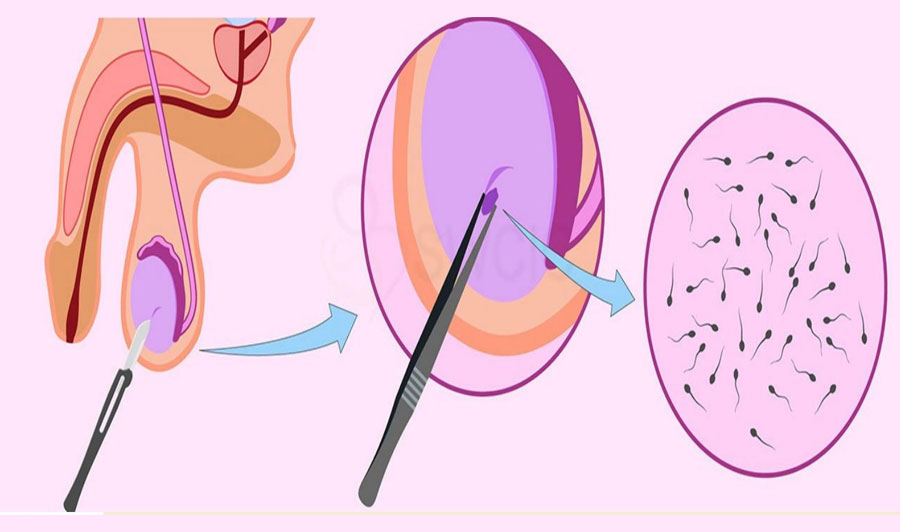
What Is PESA (Percutaneous Epididymal Sperm Aspiration)?
Percutaneous Epididymal Sperm Aspiration (PESA) is a minimally invasive surgical procedure used to collect sperm directly from the epididymis — the small, coiled tube located at the back of each testicle where sperm are stored and mature after being produced.
PESA is specifically designed for men who have sperm production in their testicles but cannot release sperm in their ejaculate due to a blockage or absence of the vas deferens. This condition is known as obstructive azoospermia. Unlike more invasive sperm retrieval methods, PESA does not require a surgical incision or the use of an operating microscope. Instead, a fine needle is inserted through the skin of the scrotum into the epididymis to aspirate (draw out) fluid containing sperm.
The sperm retrieved through PESA are then used in conjunction with intracytoplasmic sperm injection (ICSI), a specialized IVF technique in which a single sperm is injected directly into a mature egg. Because epididymal sperm are often present in lower numbers and may have limited motility compared to ejaculated sperm, ICSI is essential to achieve fertilization.
Why Is PESA Done?
PESA is performed when a man produces sperm in his testicles but the sperm cannot reach the ejaculate due to a physical obstruction or anatomical absence of the reproductive ducts. Common reasons include:
- Obstructive azoospermia — A blockage in the reproductive tract (epididymis, vas deferens, or ejaculatory ducts) prevents sperm from appearing in the ejaculate despite normal sperm production.
- Prior vasectomy — Men who have had a vasectomy and wish to father children without undergoing vasectomy reversal surgery may opt for PESA combined with IVF-ICSI.
- Failed vasectomy reversal — When a vasectomy reversal procedure has been attempted but was unsuccessful in restoring sperm to the ejaculate.
- Congenital bilateral absence of the vas deferens (CBAVD) — A genetic condition, often associated with cystic fibrosis gene mutations, where the vas deferens (the tubes that carry sperm from the epididymis to the urethra) never developed.
- Ejaculatory duct obstruction — Blockage at the ejaculatory ducts caused by cysts, scarring from infection, or prior surgery.
- Infection-related blockage — Previous infections such as epididymitis, sexually transmitted infections, or tuberculosis can cause scarring and obstruction of the reproductive ducts.
How Is PESA Performed?
PESA is a relatively quick and straightforward procedure, typically completed in 15 to 30 minutes. It is usually performed in a clinic or day-surgery setting and does not require general anesthesia. Here is what happens step by step:
Step 1: Preparation and Anesthesia
The procedure begins with preparing the patient comfortably:
- You will lie on your back on an examination table. The scrotal area is cleaned and sterilized.
- A local anesthetic is injected into the skin of the scrotum and the spermatic cord to numb the area. This is similar to the numbing injection used at a dental procedure.
- Some patients may also receive mild sedation to help them relax, though this is not always required.
- You will be awake during the procedure but should feel no pain — only mild pressure or tugging.
Step 2: Locating the Epididymis
The urologist identifies the epididymis by palpation (feeling through the skin):
- The doctor gently holds the testicle steady with one hand and locates the epididymis — the soft, tube-like structure at the back and top of the testicle.
- The head (caput) of the epididymis is usually targeted first, as it tends to contain the highest concentration of sperm.
Step 3: Needle Insertion and Aspiration
A fine needle attached to a syringe is used to collect sperm-containing fluid:
- A 21- to 23-gauge butterfly needle or fine-gauge needle connected to a syringe is inserted through the scrotal skin directly into the epididymis.
- Gentle negative pressure (suction) is applied to the syringe to aspirate epididymal fluid.
- The needle may be redirected or reinserted at a different site on the epididymis if the initial aspiration does not yield adequate fluid or sperm.
- In some cases, the procedure may need to be performed on the opposite testicle if the first side does not produce sufficient sperm.
Step 4: Immediate Laboratory Assessment
The aspirated fluid is immediately examined under a microscope by an embryologist:
- The fluid is placed on a slide or in culture media and checked for the presence, number, and motility of sperm.
- If motile sperm are found, the retrieval is considered successful and the procedure is concluded.
- If no sperm or insufficient sperm are found, the doctor may attempt additional aspirations from different areas of the epididymis.
- If PESA is unsuccessful, the surgeon may proceed to TESA (testicular sperm aspiration) or open surgical sperm retrieval during the same session.
Step 5: Completion
Once adequate sperm are obtained, the procedure is wrapped up:
- The needle is withdrawn and gentle pressure is applied to the puncture site to minimize bleeding or bruising.
- No stitches are needed — only a small adhesive bandage is placed over the puncture site.
- The retrieved sperm are processed in the laboratory and used immediately for ICSI or cryopreserved (frozen) for future use.
What to Expect After PESA
PESA is a well-tolerated procedure with a quick recovery. Most men can resume normal activities within one to two days. Here is what you can expect:
- Mild soreness or tenderness in the scrotum for one to three days, manageable with over-the-counter pain relief such as acetaminophen or ibuprofen.
- Minor bruising or swelling at the needle puncture site, which typically resolves on its own within a few days.
- You can go home shortly after the procedure, usually within one to two hours.
- Wear supportive underwear (such as a scrotal support or snug briefs) for two to three days to minimize discomfort and swelling.
- Avoid strenuous exercise, heavy lifting, and sexual activity for three to five days after the procedure.
- Apply an ice pack wrapped in a cloth to the scrotal area for 15 to 20 minutes at a time during the first 24 hours to reduce swelling.
- Most men return to desk work or light duties the next day. Physical labor may require two to three days off.
Serious complications are uncommon. However, if you develop significant swelling, increasing pain, fever, or redness at the puncture site, contact your doctor promptly as these may indicate infection or hematoma formation.
How Successful Is PESA?
The success of PESA depends on two factors — the ability to retrieve usable sperm and the subsequent pregnancy rates when those sperm are used with IVF-ICSI:
- Sperm retrieval rate — PESA successfully retrieves sperm in approximately 60% to 80% of attempts in men with obstructive azoospermia. The success rate is highest in men with clear obstructive causes such as prior vasectomy or CBAVD.
- Fertilization rate — When PESA-retrieved sperm are used with ICSI, fertilization rates of 45% to 75% per injected egg are typically achieved.
- Clinical pregnancy rate — Pregnancy rates per cycle using PESA sperm with ICSI range from 25% to 45%, depending on the female partner's age, egg quality, and other factors.
- Female partner under 35 years old — approximately 40-50% pregnancy rate per cycle.
- Female partner 35 to 37 years old — approximately 30-40% per cycle.
- Female partner 38 to 40 years old — approximately 20-30% per cycle.
- Female partner over 40 years old — approximately 10-20% per cycle.
If PESA does not yield adequate sperm, the doctor can typically proceed to TESA or micro-TESE during the same session. At Fishtail IVF, our urologists and embryologists work closely together to optimize sperm retrieval and ensure every possible effort is made to obtain viable sperm for fertilization.
What Are the Risks of PESA?
PESA is considered a safe, low-risk procedure. However, as with any medical intervention, there are some potential risks and complications to be aware of:
- Pain or discomfort — Some men experience mild to moderate soreness at the aspiration site for a few days. Significant pain is rare and usually indicates a complication that should be evaluated.
- Bleeding or hematoma — A small collection of blood (hematoma) may form at the puncture site or within the scrotal tissues. Small hematomas resolve on their own, but larger ones may require medical attention.
- Infection — There is a small risk of infection at the needle site. Signs include increasing redness, warmth, swelling, or discharge. Antibiotics may be prescribed preventively.
- Swelling — Temporary swelling of the scrotum is common and usually resolves within a few days with rest, ice, and supportive undergarments.
- Failed sperm retrieval — In approximately 20% to 40% of attempts, PESA may not yield sufficient sperm for ICSI, particularly if the obstruction is at the level of the epididymis itself. In such cases, TESA or micro-TESE can be performed as backup.
- Epididymal damage — Repeated needle insertions may cause minor scarring to the epididymis. This is generally not clinically significant but is a consideration if multiple PESA procedures are anticipated.
Serious complications such as testicular injury, chronic pain, or significant infection are extremely rare when PESA is performed by an experienced urologist. The minimally invasive nature of PESA means it carries fewer risks than open surgical sperm retrieval techniques.
PESA vs. TESA: What's the Difference?
PESA and TESA are both needle-based, minimally invasive sperm retrieval methods, but they differ in where the sperm are collected from and when each is most appropriate:
- Source of sperm — PESA retrieves sperm from the epididymis (where sperm are stored and matured), while TESA (Testicular Sperm Aspiration) retrieves sperm directly from the testicular tissue where they are produced.
- Best indication — PESA is most effective for obstructive azoospermia, where sperm production is normal but delivery is blocked. TESA can be used for both obstructive and some cases of non-obstructive azoospermia.
- Sperm quality — Epididymal sperm retrieved by PESA are generally more mature and may have better motility than testicular sperm retrieved by TESA, as the epididymis is where sperm gain their ability to swim.
- Procedure — Both are performed under local anesthesia with a fine needle. PESA targets the epididymis through the scrotal skin, while TESA involves inserting a needle into the testicular tissue itself.
- Invasiveness — Both procedures are minimally invasive, but TESA may cause slightly more discomfort as testicular tissue is being sampled directly.
- If PESA fails — If PESA does not yield adequate sperm, the surgeon can proceed to TESA or even micro-TESE (microsurgical testicular sperm extraction) during the same session to maximize the chances of sperm retrieval.
- Sperm yield — PESA may yield fewer total sperm than TESA or surgical methods, but the sperm obtained are often of higher maturity and quality when the underlying cause is obstructive.
Your urologist at Fishtail IVF will recommend the most appropriate sperm retrieval technique based on the underlying cause of azoospermia, your medical history, and prior test results. In many cases, a backup plan (such as proceeding to TESA if PESA is unsuccessful) is discussed before the procedure to ensure the best possible outcome.
Who Is a Candidate for PESA?
PESA is most suitable for men with confirmed obstructive azoospermia who have normal sperm production within the testicles. You may be a candidate for PESA if:
- You have been diagnosed with obstructive azoospermia — meaning no sperm are found in the ejaculate due to a blockage, not a production problem.
- You have had a prior vasectomy and prefer sperm retrieval with IVF-ICSI over vasectomy reversal.
- You have congenital bilateral absence of the vas deferens (CBAVD), often linked to cystic fibrosis gene carrier status.
- A failed vasectomy reversal has left you without sperm in the ejaculate.
- You have ejaculatory duct obstruction that cannot be corrected surgically.
- Your hormone levels (FSH, testosterone) and testicular size are normal, suggesting intact sperm production.
- You and your partner are planning IVF with ICSI and need a source of sperm for fertilization.
PESA is generally not recommended for men with non-obstructive azoospermia (where the testicles produce little or no sperm) because the epididymis is unlikely to contain sperm in these cases. For non-obstructive azoospermia, procedures like micro-TESE are more appropriate. Your fertility specialist at Fishtail IVF will conduct a thorough evaluation including semen analysis, hormone testing, physical examination, and possibly genetic testing to determine the best sperm retrieval approach for you.
When Should I Contact My Healthcare Provider?
While recovery from PESA is usually smooth and uneventful, you should contact your healthcare provider promptly if you experience any of the following after the procedure:
- Increasing or severe scrotal pain that is not relieved by over-the-counter pain medications.
- Significant swelling of the scrotum that continues to worsen after the first 24 to 48 hours.
- Fever over 100.4°F (38°C), which may indicate an infection.
- Redness, warmth, or discharge from the needle puncture site.
- Heavy or persistent bleeding from the aspiration site.
- Nausea or vomiting that does not resolve.
- Difficulty urinating or blood in the urine.
These symptoms are uncommon but should be evaluated promptly to rule out complications such as infection or hematoma. Do not hesitate to reach out to your care team at Fishtail IVF — we are here to support you throughout every step of the process.
A Note from Fishtail IVF
A diagnosis of azoospermia can feel overwhelming, but it does not mean that biological fatherhood is out of reach. PESA is a safe, quick, and effective way to retrieve sperm for men with obstructive azoospermia, and when combined with ICSI, it has helped countless couples achieve successful pregnancies.
At Fishtail IVF, our experienced urologists and embryologists work together as a coordinated team to give you the best chance of sperm retrieval and fertilization. We understand the emotional weight of a male infertility diagnosis, and we are committed to providing compassionate, personalized care every step of the way.
If you or your partner have been told that no sperm are present in the ejaculate, we encourage you to schedule a consultation. Together, we will explore all available options — including PESA, TESA, and micro-TESE — and develop a treatment plan tailored to your unique situation. Parenthood may be closer than you think.