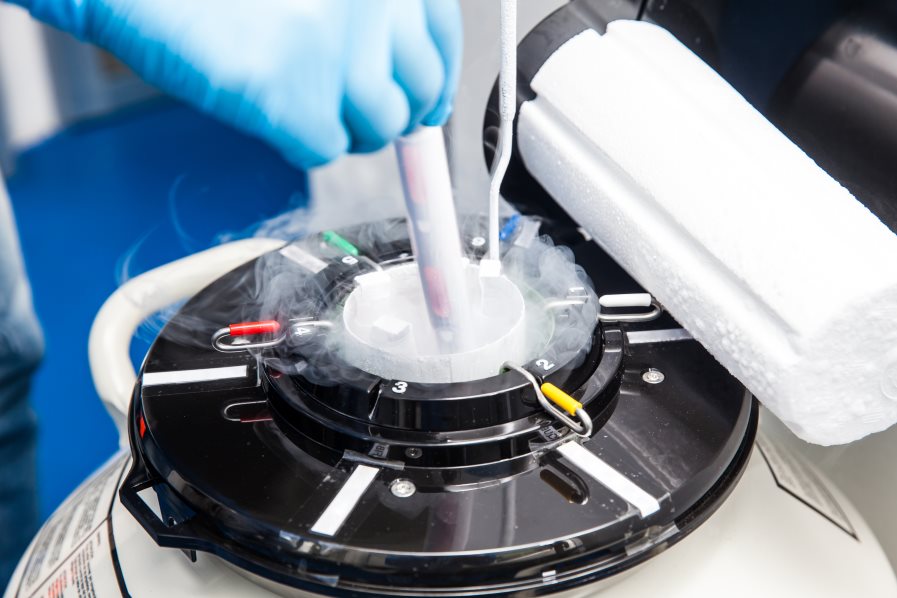
What Is Embryo Freezing?
Embryo freezing, also known as embryo cryopreservation, is a medical procedure that allows embryos created through in vitro fertilization (IVF) to be frozen and stored for future use. After eggs are retrieved and fertilized with sperm in a laboratory, the resulting embryos can be preserved at extremely low temperatures (around -196°C) using liquid nitrogen.
The most widely used method today is vitrification, an ultra-rapid freezing technique that prevents ice crystal formation within the embryo's cells. Vitrification has significantly improved embryo survival rates compared to older slow-freezing methods, with survival rates now exceeding 95%.
Embryo freezing gives individuals and couples the flexibility to preserve high-quality embryos and use them months or even years later, without any loss in embryo quality or pregnancy potential.
Why Is Embryo Freezing Done?
There are many personal and medical reasons why your healthcare provider may recommend freezing embryos:
- Surplus embryos from IVF — If your IVF cycle produces more viable embryos than are transferred in a single cycle, the remaining embryos can be frozen for future attempts, reducing the need for additional stimulation and retrieval cycles.
- Fertility preservation before cancer treatment — Chemotherapy, radiation, and certain surgeries can damage fertility. Freezing embryos before treatment begins allows you to protect your ability to have biological children afterward.
- Elective fertility preservation — Some individuals or couples choose to freeze embryos when they are younger to preserve their fertility for a later date, such as when focusing on career, education, or personal goals.
- Preimplantation genetic testing (PGT) — Embryos may need to be frozen while awaiting results from genetic testing to identify chromosomally normal or disease-free embryos before transfer.
- Risk of ovarian hyperstimulation syndrome (OHSS) — If you develop or are at high risk of OHSS after ovarian stimulation, your doctor may recommend freezing all embryos and postponing the transfer until your body has recovered.
- Uterine lining concerns — If the uterine lining is not optimally prepared during the stimulation cycle, freezing embryos for a later frozen embryo transfer (FET) cycle may improve implantation chances.
- Donor egg or surrogacy arrangements — Embryos created using donor eggs or intended for gestational carriers are often frozen to coordinate timing between parties.
- Military deployment or personal circumstances — Life situations that require delaying pregnancy can be managed by freezing embryos until the time is right.
How Does Embryo Freezing Work?
The embryo freezing process is carried out as part of an IVF cycle. It involves several carefully coordinated steps over the course of a few weeks:
Step 1: Ovarian Stimulation
The process begins with hormone medications (gonadotropins) to stimulate your ovaries to produce multiple eggs rather than the single egg that normally matures each month.
- Injectable fertility medications are taken daily for about 8 to 14 days.
- Your doctor will monitor follicle growth through regular transvaginal ultrasounds and blood tests to track estrogen and other hormone levels.
- Medication doses may be adjusted based on your response.
- A trigger shot (hCG or GnRH agonist) is given when the follicles have reached the right size, typically 18-20mm, to finalize egg maturation.
Step 2: Egg Retrieval
Approximately 34 to 36 hours after the trigger shot, the eggs are collected in a minor outpatient procedure.
- The procedure is performed under light sedation or anesthesia and takes about 15 to 30 minutes.
- A thin needle is guided through the vaginal wall into each ovarian follicle using ultrasound imaging.
- The fluid containing the eggs is aspirated from each follicle.
- You may feel mild cramping or bloating afterward but can usually go home the same day.
Step 3: Fertilization
Once the eggs are retrieved, they are fertilized with sperm in the laboratory to create embryos.
- Conventional IVF — Eggs and sperm are placed together in a culture dish, and fertilization occurs naturally.
- Intracytoplasmic sperm injection (ICSI) — A single sperm is injected directly into each mature egg. This is often used when sperm quality is a concern.
- Fertilization is confirmed the next day by checking for the presence of two pronuclei (one from the egg and one from the sperm).
Step 4: Embryo Culture
The fertilized embryos are cultured in the laboratory under carefully controlled conditions for several days.
- Embryos are grown in specialized incubators that mimic conditions inside the body, maintaining precise temperature, humidity, and gas concentrations.
- Embryologists monitor embryo development daily, assessing cell division and quality.
- Embryos are typically grown to the blastocyst stage (Day 5 or Day 6), which allows better assessment of embryo quality and improves both freezing outcomes and future pregnancy rates.
- If preimplantation genetic testing (PGT) is planned, a small biopsy of cells is taken from the blastocyst at this stage.
Step 5: Vitrification (Freezing)
Embryos that meet quality standards are frozen using vitrification, the gold-standard cryopreservation technique.
- Embryos are treated with cryoprotectant solutions that replace water inside the cells, preventing damaging ice crystals from forming.
- The embryos are then plunged into liquid nitrogen at -196°C, freezing them almost instantaneously.
- Each embryo is placed on a specially labeled storage device (cryotop or straw) and stored in secure liquid nitrogen tanks.
- Vitrification achieves embryo survival rates of over 95% upon thawing.
What to Expect During and After Embryo Freezing
Understanding what to expect throughout the process can help you feel more prepared and less anxious:
- During ovarian stimulation — You may experience bloating, mild pelvic discomfort, mood swings, and breast tenderness from the hormone medications. These side effects are temporary.
- After egg retrieval — Mild cramping, spotting, and bloating are common for a few days. Most people return to normal activities within one to two days.
- Emotional aspects — The process can be emotionally demanding. It is normal to feel a mix of hope, anxiety, and relief. Counseling and support are available.
- Timeline — The entire process from the start of stimulation to embryo freezing takes approximately two to three weeks.
- Follow-up — Your doctor will discuss how many embryos were successfully frozen, their quality grades, and your options for future use.
After the egg retrieval, your role in the process is complete. The fertilization, culture, and freezing steps are handled entirely by the embryology team in the laboratory. You will be kept informed of embryo development progress.
There is no embryo transfer during a freeze-all cycle. When you are ready to use your frozen embryos, you will undergo a separate frozen embryo transfer (FET) cycle, which is a simpler and less invasive process.
What Are the Success Rates of Embryo Freezing?
Embryo freezing has become one of the most reliable techniques in reproductive medicine. Success is measured at multiple stages:
- Embryo survival after thawing — With vitrification, over 95% of frozen embryos survive the thawing process with their quality intact.
- Pregnancy rates per frozen embryo transfer — Success rates are comparable to or even higher than fresh embryo transfers. For women under 35 (at the time of egg retrieval), pregnancy rates per transfer are approximately 50-60%.
- Age at egg retrieval matters most — The age when the eggs were retrieved is the key factor, not the age at which the embryo is eventually transferred. Embryos frozen from eggs retrieved at age 30 retain the same pregnancy potential even if used years later.
- Blastocyst-stage embryos — Embryos frozen at the blastocyst stage (Day 5 or 6) generally have higher survival and implantation rates than those frozen at earlier stages.
- Cumulative success — Having multiple frozen embryos increases your overall chances of a successful pregnancy across one or more transfer cycles.
It is important to understand that not all eggs will fertilize, not all fertilized eggs will develop into viable embryos, and not all embryos will be suitable for freezing. Your fertility team will give you realistic expectations based on your individual situation.
At Fishtail IVF, we use the latest vitrification protocols and embryo culture systems to maximize the number of high-quality embryos available for freezing and future use.
What Are the Risks of Embryo Freezing?
Embryo freezing is considered a safe and well-established procedure. However, like any medical process, there are some risks to be aware of:
- Ovarian hyperstimulation syndrome (OHSS) — The hormone medications used to stimulate the ovaries can sometimes cause the ovaries to over-respond, leading to abdominal swelling, pain, nausea, and in rare severe cases, blood clots or kidney problems. Your doctor will monitor you closely to minimize this risk.
- Egg retrieval complications — Rare risks include bleeding, infection, or injury to surrounding structures (bowel, bladder, or blood vessels). These complications are uncommon.
- Embryo not surviving the thaw — Although vitrification has a survival rate above 95%, a small percentage of embryos may not survive the freezing or thawing process.
- No guarantee of pregnancy — Having frozen embryos does not guarantee a future pregnancy. Success depends on embryo quality, age at retrieval, uterine receptivity, and other factors.
- Medication side effects — Fertility medications can cause headaches, bloating, mood changes, injection site reactions, and breast tenderness.
- Emotional and psychological stress — The process can be stressful, particularly when dealing with uncertainty about future outcomes. Support resources are available.
- Ethical and legal considerations — You will need to make decisions about the disposition of unused embryos (continued storage, donation, disposal, or use in research). These decisions should be discussed with your partner and your care team.
Embryo Freezing vs. Egg Freezing
Both embryo freezing and egg freezing are forms of fertility preservation, but they differ in important ways. Understanding these differences can help you decide which option is right for you:
- Fertilization stage — In embryo freezing, eggs are fertilized with sperm before freezing. In egg freezing (oocyte cryopreservation), unfertilized eggs are frozen.
- Partner or donor sperm required — Embryo freezing requires sperm at the time of the procedure, meaning you need a partner or sperm donor. Egg freezing does not require sperm until you are ready to use the eggs.
- Survival rates — Frozen embryos generally have slightly higher survival rates after thawing compared to frozen eggs, because embryos are more resilient at the cellular level.
- Flexibility — Egg freezing offers more flexibility for individuals who do not yet have a partner or are unsure about their sperm source. Embryo freezing is often preferred by couples who are ready to commit to building embryos together.
- Success rates — Embryo freezing tends to have marginally higher success rates overall, since the fertilization step has already been completed and embryo quality can be assessed before freezing.
- Legal ownership — Embryos may involve shared legal ownership between both genetic parents, which can become complex in the event of separation or disagreement. Frozen eggs belong solely to the individual who provided them.
- Who is it best for — Egg freezing is ideal for individuals preserving fertility independently. Embryo freezing is typically recommended for couples undergoing IVF or those who have a known sperm source and want to maximize their chances.
Your fertility specialist at Fishtail IVF can help you evaluate which option aligns best with your medical situation, relationship status, and family-building goals.
How Long Can Embryos Stay Frozen?
Embryos can be stored frozen indefinitely without any deterioration in quality. There is no known time limit on how long embryos can remain safely cryopreserved.
Because vitrification essentially halts all biological activity, a frozen embryo does not age. Embryos frozen for one year have the same potential as those frozen for ten or even twenty years. There have been documented cases of healthy babies born from embryos frozen for over 25 years.
Storage involves keeping the embryos in secure liquid nitrogen tanks at -196°C. At Fishtail IVF, our cryostorage facility is equipped with 24/7 monitoring systems, alarm notifications, and backup equipment to ensure the continuous safety of your stored embryos.
You will be asked to pay an annual storage fee to maintain your frozen embryos. It is important to keep your contact information up to date with the clinic and to communicate your wishes regarding the embryos over time.
When Should I Contact My Healthcare Provider?
During or after the ovarian stimulation and egg retrieval phases of the embryo freezing process, contact your healthcare provider right away if you experience any of the following:
- Severe abdominal pain or swelling that worsens over time
- Heavy vaginal bleeding (soaking more than one pad per hour)
- Fever above 100.4°F (38°C)
- Difficulty breathing or shortness of breath
- Severe nausea, vomiting, or diarrhea
- Decreased urination or dark-colored urine
- Dizziness, fainting, or rapid heartbeat
- Signs of infection at the injection site, such as redness, warmth, or pus
These symptoms may indicate complications such as ovarian hyperstimulation syndrome (OHSS), infection, or internal bleeding. Early intervention leads to better outcomes, so do not hesitate to reach out to your care team at Fishtail IVF if something does not feel right.
A Note from Fishtail IVF
Embryo freezing is one of the most empowering options available in modern reproductive medicine. Whether you are preserving fertility before medical treatment, planning ahead for the future, or storing extra embryos from an IVF cycle, cryopreservation gives you the gift of time without compromising your chances of having a healthy baby.
At Fishtail IVF, we understand that the decision to freeze embryos is both deeply personal and medically significant. Our experienced fertility specialists, embryologists, and support staff are committed to guiding you through every step of the process with expert care and compassion.
We use the most advanced vitrification technology and laboratory standards to ensure your embryos are preserved safely and effectively. From your first consultation to the day you are ready to use your frozen embryos, we are here to support your journey to parenthood.